

My Most Popular Print From The Coast Mountains... But Why?

When I was photographing this scene in the summer of 2023 I never expected it would become my best-selling print and one of my most popular photos from the Coast Mountains. I wasn't even shooting for myself at the time - I was demonstrating composition for someone else to help build their skills! Recently I was trying to figure out why people seem to love it so much, particularly compared to other photos that I like more, so I figured it would be a good candidate for an instructional about-the-photo blog. Maybe it's just the lush wildflowers and beautiful blues, but I feel like there's more to it than that!
So here's a breakdown of The Dreamer, from composition to the edit.
One of the big draws for this photo is the feeling of depth. This is something I always aim for in my photos, but here it's very pronounced due to side and back lighting combined with a thin layer of haze from distant fires. The foreground, midground and background are all very distinctly separated. But perhaps more importantly, they are all connected in pleasing ways by composition. I made a crude series of visualizations to help show what I mean.

First, leading lines from the creek draw the viewer's eye into the frame. But they don't leave you stranded! (Technically I've displayed the leading lines as curves, but you could represent them as lines instead and the effect would be the same. I just felt it made things easier to digest for this demonstration.)

There are two converging lines that come from the midground, meeting up with the leading lines at various points. This gives the composition some room to breathe, while ensuring the eye doesn't get lost. Interestingly they also create a feeling of symmetry, despite the composition not being symmetrical. Our brains love symmetry!

It's not over yet though - the leading line continues, working its way into the mountains. The foreground, midground and background are now all directly connected in a pleasing way.
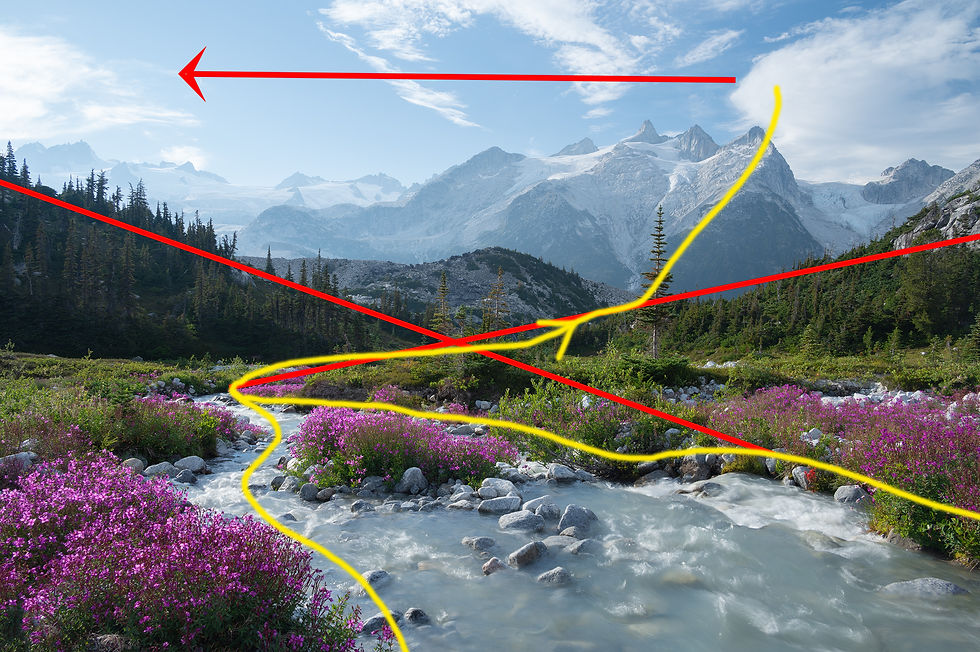
To finish things off, the clouds act as a subtle guiding line that brings the viewer to the brightest part of the photo, and then back to one of the converging lines, making a full compositional loop. The eye is never left stranded or lost in the image, and there are various contrasts/balances throughout the photo that add extra interest along the way!
If you've ever heard me ramble about composition, you're already aware of how much value I place on creating, emphasizing and utilizing different forms of contrast and balance. The beauty of these things is that they can be found everywhere. If you want an easy way to do this, take a look at something, and then find its opposite. That's a contrast or a balance. In the photo we have:
Smooth water and sky, balanced by roughly textured flowers, rocks and foliage.
It's subtle, but the foreground is darker than the background.
The symmetrical converging lines have a dark/light contrast.
Colour harmony! The flowers are on the opposite side of the colour wheel from the greens. If we stopped there it would be a complementary colour harmony, but in between those colours on the wheel are the blues, making it a nicely balanced triadic harmony.
The more forms of contrast and compositional structure that you can work into a shot, the better! Well, not always, but I'd say most of the time this is true in traditional landscape photography. Now, let's take a look at the editing.
These days I try to keep my edits more subdued than in the past - I much prefer to find that amazing light in real life than attempt to create it in post. With the right light and composition, you really don't need to do much editing to simplify and elevate a scene. The Dreamer is the perfect example of this. The light was so good I barely had to do anything in Photoshop! Here's a JPEG rendition of the two raw files, straight out of camera without any of my adjustments:


There are two raw files for this photo because I wanted to smooth out the water with a longer exposure, while keeping all the other details nice and sharp. A shutter speed of 1/6th of a second allowed me to do this, although I had to close down the aperture to f/22 to avoid overexposure, as I do not use neutral density filters.
Blending these together was simple enough, and then I tackled the rest of the edit:
Clean up the distractions and dust spots. First I cropped to remove some of the distracting elements that might pull the viewer's eye out of the photo. Then I used a healing brush to remove the rest... including pesky dust spots!
Reduce highlight strength in the background.
Increase shadows a little bit.
Cool down the image by nudging some cyans and blues into the midtones, using the Color Balance tool.
Localized saturation increase on the flowers.
A smaller saturation increase to the water and greenery.
Further brightening of the midground and background using the Curves tool, targeted more to the shadows and midtones.
And that's it! No Orton effect, no warping, no light painting. However, I am entering this photo into the Natural Landscape Photography Awards and they don't allow the removal of non-transient objects, so I created a variant that uses a single exposure and different techniques to minimize the edge distractions. Instead of using a healing brush to remove things, you can do things like crop a bit more or do some selective darkening! To get a better idea of what seeing (and hearing) this was all like in person, here's a video I took:
It makes me happy that so many people have decided to have The Dreamer printed for their walls. There's something special about seeing your work come to life in print form, and how happy people get when they first get to see it!
Hopefully you enjoyed this look into my process, and perhaps even learned something! If you'd like to do a composition deep dive, my webinars are currently 50% off... including a 4+ hour webinar that Matt Jackisch and I gave on the topic of composition!
More info can be found below. Discount will be applied automatically in the cart.
https://www.tristantodd.photography/webinars
And if you like to live dangerously and impulse buy things... well, you can do that too with the button(s) below!


Comments